To effectively implement the Vision and Mission, the Council has an elaborate governance structure that formulates policies and provides oversight over the management. The structure has the following organs:

Board of Trustees

The Registered Trustees of the National Council of Churches of Kenya was incorporated under the Trustees (Perpetual Succession Act) Cap 164 of the Laws of Kenya on March 20, 1952. The Trustees hold land, interests in land and all other assets of the NCCK.

The Trustees are ex-officio members of the Council's General Assembly and the Executive Committee.

General Assembly

This is the supreme governing body of the Council. It meets once every three years, and brings together delegates from the membership and the regions. The General Assembly formulates overall Council policy and deals with all matters relating to the NCCK Constitution

Executive Committee

This is the executive arm of the General Assembly, and meets two times a year. It consists of representatives of the membership and the regions. It undertakes general executive functions in between the General Assembly meetings.

Finance and Administration Committee

This committee deals with financial, human resource and administration policy matters

Programme Committee

Bringing together the heads of member churches and organisations, this committee provides policy guidance to the programme work of the Council

Membership Committee

This committee considers and gives guidance regarding applications for membership.


Regional Structure

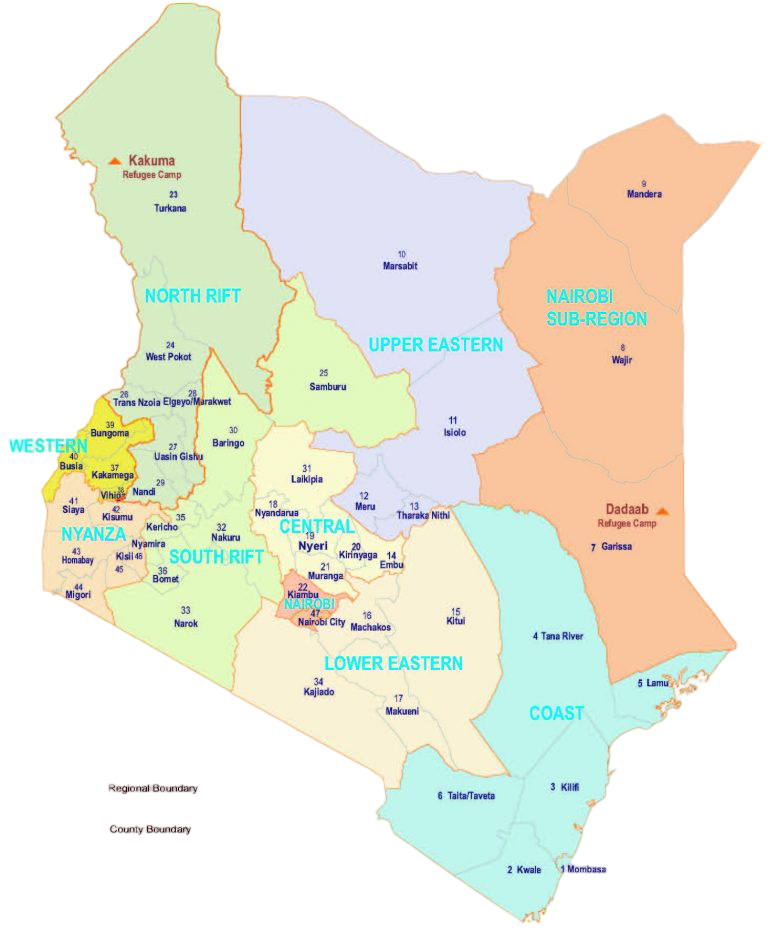
To enhance its grassroots reach, the Council has devolved to regions and counties. In this structure, the member churches and organisations come together at the county level to form a County Coordinating Committee (CCC), and then five or six counties are clustered to form a region. The Council has thus divided the country into nine regions, which serve as the primary theater of activity.

To effect the regional structure, the following organs have been established:

i.       Regional Conference

This brings together representatives of member Churches and organizations within the Region. It meets once every three years in between the Council’s General Assemblies.

ii.       Regional Committee

This is the executive arm of the Regional Conference, and meets twice a year. It is responsible to the Regional Conference, and works closely with the Council staff at the Regional office.

iii.      County Coordinating Committee

These are set up to facilitate the work of the Regional Committees at the County Level. They are answerable to the Regional Committee.

NOTE: Regions do not have legal autonomy separate from the Council, and their decisions must be in accord with the decisions of the Council’s national governing organs as well as the Council’s corporate Vision, Mission, Values and Plans.

TOP

Write a review